Long Form Content Vs Short Form Content. What works in 2026?
Should you be publishing more in-depth blogs every month? Or should you double down on daily LinkedIn posts, Instagram Reels, and bite-sized content instead?
Most content marketers wrestle with this. Some swear long-form content should take precedence, while others claim short-form is all anyone actually consumes in 2026.
Both sides have a point, but neither tells the full story.
This guide breaks down where long-form vs short-form content fit into a modern marketing strategy in 2026. You’ll learn when each format works best, why search engines reward certain types of content, and how to build a content strategy that delivers measurable business results, not just vanity metrics.
Before we dive in, let’s clearly define what long-form and short-form content are!
What Is Long-Form Content?
Long-form content is comprehensive content that explores a topic in depth, typically exceeding 1,500 words and designed to educate, answer complex questions, and build long-term authority.
Unlike quick updates or social posts, long-form content gives readers the full picture in one place – context, examples, research, expert takes, and actionable advice. It answers not just one question, but all the related ones, which is exactly what search engines now reward.
For small businesses, long-form content is a digital asset that continues attracting visitors months – or even years – after publication.
Common long-form examples include:
- Ultimate guides
- Pillar pages
- Case studies
- White papers
- Industry reports
- Detailed tutorials
- Comprehensive buying guides
Long-form content earns attention slowly – but keeps earning it long after publishing.
A Semrush Content Marketing Report found that long-form articles frequently generate more backlinks, higher dwell time, and greater organic visibility than shorter pages covering the same topic.
That doesn’t mean every article needs to hit 3,000 words. It means depth matters when people want real answers.
How does Long-Form Content Help Businesses?
- Builds topical authority
- Improves organic search visibility.
- Earns backlinks naturally
- Increases average time on page.
- Generates qualified leads
- Supports AI search experiences.
- Creates evergreen marketing assets.
Long-form content doesn’t just answer the question – it answers the next five your customer hasn’t even thought of yet.
What Is Short-Form Content?
Short-form content delivers a single, focused idea quickly, usually in fewer than 600 words if written or within seconds if it’s a social media reel. Since most of it is consumed on mobile devices, it’s designed to be easy to scan, swipe, and share.
People consume short-form content during small moments throughout the day. Waiting for coffee. Commuting. Between meetings. Scrolling before bed.
Because attention spans are fragmented across dozens of platforms, concise content helps brands stay visible without demanding a large time commitment from audiences.
Instead of covering everything, it lands one clear message your audience gets instantly.
Short-form examples include:
- LinkedIn posts
- Instagram carousels
- Short blogs
- Email newsletters
- Reels
- TikTok videos
- YouTube Shorts
- X (Twitter) threads
- Facebook posts
Short-form content sparks conversations. Long-form content closes the deal.
How is Short-form content helpful for businesses?
- Increases brand awareness
- Builds daily visibility
- Drives social engagement
- Encourages shares
- Supports community building
- Promotes products
Sends visitors toward deeper resources.
Long-Form vs Short-Form Content: Which Builds More Trust?
Long-form content builds trust by showing expertise. Short-form content builds familiarity by showing up again and again.
You may recognise a brand after seeing twenty Instagram posts. That creates awareness.
But when you’re about to invest serious money, sign a contract, or pick a long-term partner, you’ll look for detailed resources that prove the company knows its stuff.
That’s where long-form content wins.
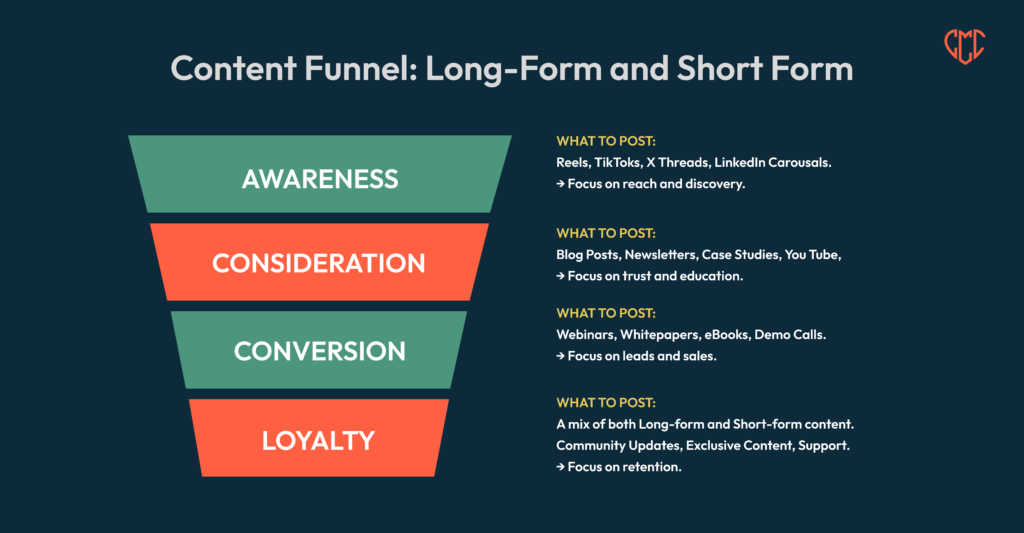
Neither replaces the other – they make each other stronger.
Long-Form vs Short-Form Content: Which Delivers Better ROI?
The best ROI doesn’t come from picking one format. It comes from combining both into a connected content engine.
Too many businesses compare the cost of a detailed blog to a handful of social posts.
That’s the wrong comparison.
A single high-quality guide can become dozens of smaller assets. Likewise, successful short-form posts can reveal which topics deserve deeper exploration.
Think of long-form content as the source.
Think of short-form content as the distribution.
Together, they maximise the return on every hour you invest in content creation.
Here’s What One Blog Can Become
One 2,500-word article can easily be repurposed into:
- 10 LinkedIn posts
- 8 Instagram carousel posts
- 5 email newsletters
- 4 short videos
- 15 social graphics
- Multiple FAQs
- A downloadable checklist
- Podcast discussion points
Instead of constantly creating from scratch, you’re multiplying the value of one well-researched resource.
That’s a far more sustainable strategy for small businesses with limited budgets.
Pro Tip
- Create once.
- Repurpose strategically.
- Distribute everywhere your audience spends time.
Which Format Should You Choose for Different Business Goals?
Every successful content strategy begins with one simple question:
“What do I want this piece of content to achieve?”
Once you’re clear on the outcome, choosing the right format becomes much easier.
Goal / Scenario | Recommended Approach | Why It Works |
Build brand awareness | Short-form content | Quick, engaging posts increase visibility and reach new audiences. |
Improve Google rankings | Long-form content | Comprehensive articles answer search intent and build topical authority. |
Generate qualified leads | Long-form + Short-form | Social content attracts prospects, while detailed resources convert them. |
Launch a new product or service | Short-form supported by long-form | Short-form creates excitement; long-form answers buyer questions. |
Establish industry expertise | Long-form content | Research-backed articles build credibility and trust over time. |
Increase customer engagement | Short-form content | Frequent interactions keep your brand top of mind. |
Support sales conversations | Long-form content | Case studies, guides, and FAQs reduce buyer uncertainty. |
Maximize content ROI | Repurpose long-form into multiple short-form assets | One authoritative article can fuel weeks of marketing content. |
How AI Is Changing Long-Form vs Short-Form Content
AI hasn’t made content less important. It’s just made genuinely useful content easier to spot – and generic content easier to skip.
Businesses can now crank up thousands of words in minutes.
So can everyone else.
That means the edge isn’t in producing more content.
It’s in producing better content that demonstrates:
- First-hand expertise
- Original insights
- Practical examples
- Clear structure
- Helpful answers
- Trustworthy sources
The future belongs to businesses that blend human expertise with AI speed – not those who go all-in on automation.
Final Take: What Actually Wins in 2026?
Neither of these content formats win solo. Together, they build what neither can do alone.
Short-form content earns attention.
Long-form content earns trust.
One starts the relationship.
The other strengthens it.
Businesses that get this create content that serves their audience at every stage of the journey.
Frequently Asked Questions
Is long-form content still worth creating in 2026?
Yes. Long-form content remains one of the strongest ways to build search visibility, demonstrate expertise, and earn qualified traffic. While AI has accelerated content creation, it has also increased the value of original insights, practical experience, and genuinely helpful resources.
How long should long-form content be?
There isn’t a universal word count. Most authoritative articles range from 1,500 to 3,000 words, but the ideal length depends on the topic’s complexity and the user’s search intent. Your goal is to answer the question completely – not simply write more words.
Can short-form content improve SEO?
Not directly in the same way as long-form articles, but it plays an important supporting role. Short-form content increases brand awareness, drives traffic to your website, earns engagement, and encourages people to discover your longer resources.
Should small businesses focus on blogs or social media?
Both. Social media helps people discover your business, while blogs help them trust your expertise. Businesses that connect these two channels typically create a stronger, more sustainable marketing strategy than those that rely on either channel alone.
How often should I publish long-form content?
Quality matters more than frequency. For most small businesses and growing startups, publishing one well-researched long-form article each month, supported by consistent short-form content throughout the week, is a realistic and highly effective approach.
How do I measure whether my content strategy is working?
Measure results against your business goals, not vanity metrics. Track organic traffic, keyword rankings, qualified leads, conversion rates, engagement, time on page, newsletter sign-ups, and enquiries. These indicators reveal whether your content is contributing to business growth.
